Showing posts with label kyoto. Show all posts

Sannen-zaka - A Walk Down Memory Lane

The photo above is a part of Kyoto-shi (Kyoto City) in Kyoto-ken (Kyoto Prefecture) in Japan. This section of town is known as Sannen-zaka, which translates to 'three-year hill'.

The street has been restored to the glory of two hundred years previous, and aside from the style of dress and the excessive electrical lines above, one does get the feeling of being a wandering ronin (masterless samurai) looking to purchase a fine meal at a small inn and hopefully find a job that will allow him to stay a while longer in the city.

Along with the nearby Ninen-zaka (two year hill), the street is named after when the roads were laid out when the Imperial City of Kyoto was first built in and around the 8th century AD.

Both streets are laid out with old style wooden buildings featuring homes, traditional shops, tourist shops (of course) and restaurants.  

In the photo above that I took in 1993 during Golden Week, you can tell that it had rained earlier that morning - what with the slick street and the washed out sky. Of course it rained. I am the Ame Otoko (Rain Man), and it always rains when I travel in Japan.

My traveling companion for this week-long trip was the foxy Trisha Pepper, who spoke Japanese fluently (thank god - a trip upon which I didn't get lost!!!), and she had red hair. Two out of three for me! Bigger boobs was the missing third.

I kid. I don't really care about boobs.

You were expecting a follow-up joke, weren't you? I can be serious sometimes. 

Trisha was one of the smartest people I ever met in Japan (excluding maybe Kristine, Nobuko and Junko - a 4-way tie!). That statement will upset my buddy Matthew, so let me rephrase it to say the 'smartest woman'.

She also had a wicked sense of humor, that sadly was better than my own. No. I did not sleep with her. She had a boyfriend back home, and as far as I was concerned, she remained faithful. Damn right I would have slept with her if given half a chance. Crazy chick could hold her alcohol, too! You will meet Trisha soon enough.

For those of you who may not know, Kyoto translates to 'capital city' and was indeed once the imperial capital of Japan. Now with 1.5 million people, 1,000 temples and better weather now that I have left, Kyoto is the capital of the same-named prefecture.

By the way: Kyo-to... To-kyo...  it was done for a reason...

Cheers,
Andrew Joseph

And yes... the photo belongs to Andrew Joseph. For non-commercial purposes, anyone may use it if you note that I am the photographer. 

As you may have noticed, I completely changed the look of this blog. It looks slick, doesn't it. If you are having a difficult time navigating it, so am I. If it wasn't for me leaving my You Know What I Hate blog as it was, I would not be able to get into the damn blog to add new article - in fact... I wouldn't even be able to change it back to the old version (if I wanted to), because the buttons I have that allow me to do that are not showing up. I can still get around this and my other two blogs - How To Survive Women is also graced with a new look - but it ain't easy. Oh the suffering I do for my art! 

Does MagLev Train Battle Have Historical Implications?

Presented for you today is a very interesting article written by Eric Johnston, a staff writer with the Japan Times Online. It was shown to me by my pal Mike Rogers of Marketing Japan blog fame.

He showed me this tale of Japan's desire - and plan - to construct a Maglev train line between Tokyo and Nagoya (to be completed by 2027) and continuing that same line to Osaka, which will hopefully be completed by 2045. I hope I live long enough to see them both.

A Maglev, (while unfortunately not discussed in the article) is exactly what it sounds like: magnetic levitation. This train will run with the awesome power of magnets, which only sounds weird until you recall that the magnet will push the train up above a rail system so that there is no friction, meaning the train will be able to propel itself along the guide a heck of a lot quicker than a standard shinkansen (bullet train).

It's also supposed to travel 500 kph. See the exciting video below! 

Further background, and grist for thought, is that there is a political battle going on right now between two cities to gain a train stop for the Maglev between the Nagoya-Osaka run. It's a battle between the cities of Nara and Kyoto, to gain the almighty tourist buck.  

Now... way back in the early part of the 8th century, 710 AD, to be exact, Nara was considered the central power, and thus the capital of Japan. 

The Nara of this era was beautiful (and still is, I hear), and it had grown large from its trade with China, being influenced in art, sculptures and culture.

But then the capital was moved to Nagaoka in 784 AD and then again in 794 AD to Kyoto.

Most people who travel to Japan put Kyoto high on the list of places to see, as it has over 1,000 temples... but Nara, despite its stunning architecture, it's not that high up on the list. I know I did not visit it, but my culturally advanced friend Matthew Hall did.

I lived in Japan during the pre-Internet days of 1990-1993, or at least there wasn't any talk of the Internet where I lived, but even I had heard of Kyoto, and knew next to nothing of Nara, except what I read about in a history book or three that I read my first month in the country.

So... what to do you think? I'm just going to put this out there, but this tourism battle battle for the train station, besides the economic implications, also has some historical significance to it.

Here's the Japan Times Maglev story - I hope you enjoy reading it as much as I did.

A CAPITAL IDEA

And, again - thanks Mike!

Kiyomizu-dera in Kyoto

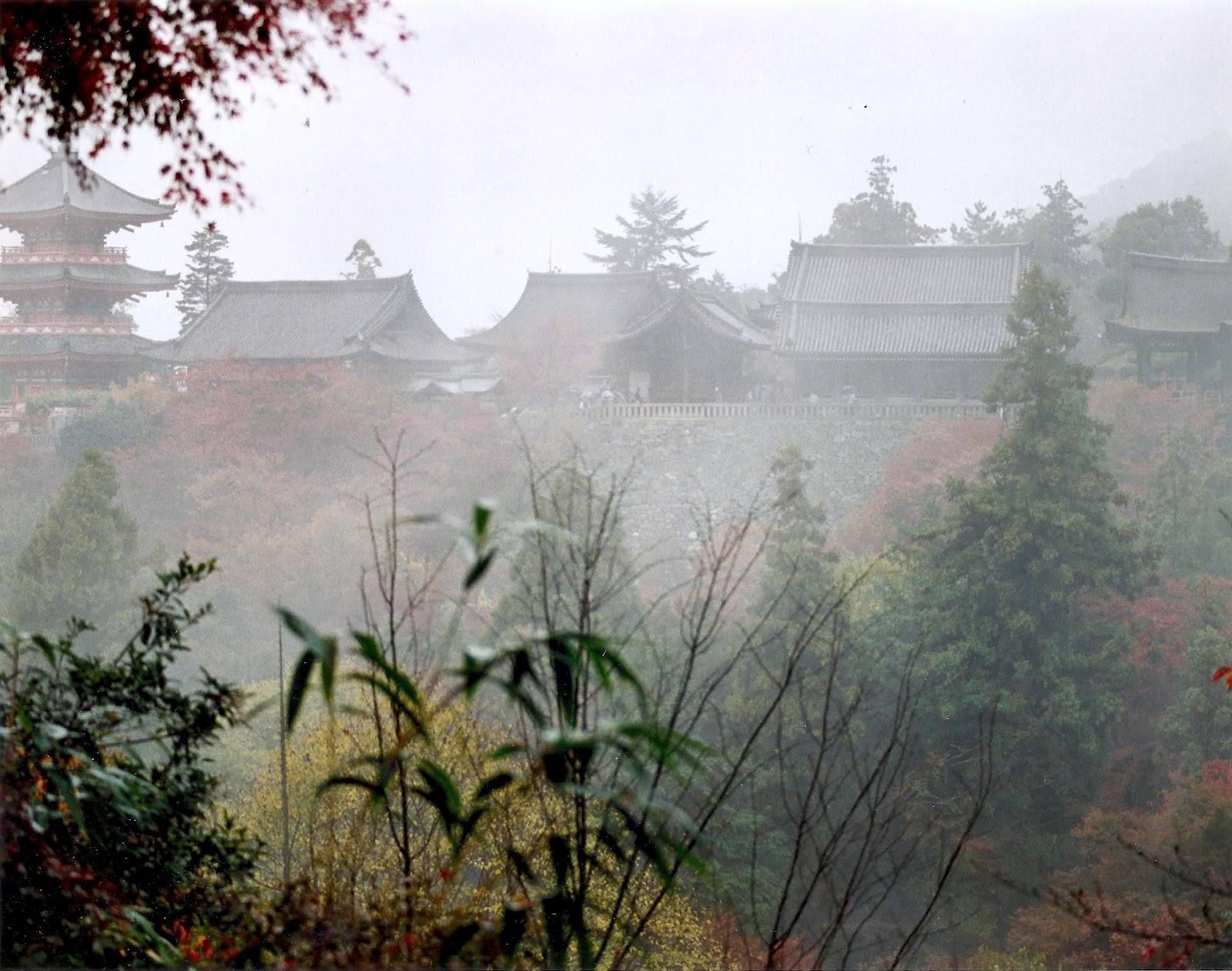
Here's a photo up above of a very popular temple in Japan. It's Kyomizu-dera in Kyoto. What is unusual about this photo is that it is not your typical photograph of the temple.

There is a portion of the temple which juts out over a cliff... and that is what people photograph. Not me, of course. I was far, far away and used a 150mm telephoto lens to shoot through the awesome, romantic mist to get this shot of the temple complex. At this time in my artistic photographic life, I liked to frame my subjects with nearby overhanging natural foliage. 

Of course... I could be wrong and this isn't actually Kyomizu-dera because I stupidly never marked my photographs figuring that even 20 years after the fact I would remember a vista as spectacular as this.  

So... I'm going to go out on a limb overhanging a cliff and suggest that the photo is exactly what I say it is.... despite it not showing off the awesome cliff scene plumbed from Wikipedia below:
While I believe my photo shows a straight on view of the cliffs... and hours spent researching it in-line proved nothing (okay - minutes)... I feel awkward about this... still what the hell...  it's me. I am awkward usually.

So... some background on Kiyomizu-dera (dera/tera means temple). It's official name is Otowa-san Kiyomizu-dera (音羽山清水寺), and it is a Buddhist temple, and the main temple that looks over the cliff was built in 778, with the other parts of the complex built around it in 1633.

Kiyomizu means pure water, and is taken from the waterfall below the main hall where if you drink from the waters you are supposed to be granted the ability to do well in studies. Or, if you prefer, since there are three streams of the waterfall... each stream is supposed to grant a different type of boon. Use at your own risk and wish you don't mix up the streams. Never cross the streams.

Now... with such a view, what is it that people like to do? Why jump off it, of course. While now prohibited, it was once believed that if one jumped off the temple and survived the 13-meter (42.65-feet) landing, your wish would be granted. Hopefully that wish was to survive the jump. Still, during the Edo -jidai (the Edo Period of 1603-1868) there were an official 234 jumps with and an astounding 85.4% survival rate.

Sounds like some jumpers got greedy and rather than wish for survival wished for something trivial like food, a healthy child in a happy family or to be the leader of Japan.

Anyhow... this national treasure of a building, was actually built without a single nail, which boggles my mind.

If I am correct, there was something going on that day I visited Kiyomizu-dera, and I couldn't get into the actual main temple because it was raining and there was construction going on. Or, I was broke and didn't have the cash, or I was tired and wet from the rain which follows me on every vacation or trip out of Ohtawara-shi, Tochigi-ken where I was living 500 kilometers away, or my traveling partner, the gorgeous and freckly redheaded Trisha Pepper and I were just too beat to get there after traveling around the prefecture for a week.

I do recall that while Trisha and I were all for seeing the tourist sites, we tried to find ways to see them that were off the beaten path. And no, we didn't sleep together, though I would have liked nothing better. Friends with benefits we were. Unfortunately, the benefits were her speaking damn near perfect Japanese as a CIR (Coordinator for International Relations) on the JET Programme, and me being the muscle to keep her safe (apparently even from me - dammit!).

Back to the data: the whole temple complex (my photo above), obviously has more to it than just a spectacular view of where 14.6% of the people jumping for the joy of wishing died. There's the the cool Jishu Shrine dedicated to the god of love and good matches (not cupid or a website, but: Ōkuninushi) ... hmm, perhaps another reason why Trisha and I never made it there.

Despite her having a sense of humor to rival my own, and she's a natural redhead (though the unnatural redhead is a prey worth delving into as far as I am concerned as I love redheads), she did have a boyfriend back home... and I do believe that congratulations are in order to Trisha because I think she was the only person to come to Japan with a significant other left back home, and to be faithful. Even I couldn't convince her, and damn it, 20 years ago, it was a hell of a lot easier to sway a woman over to the dark side of the force, if you know what I mean, young Jedi.     

At the Jishu Shrine... there are two small love stones that are six meters (~20-feet) away from each other. Lonely visitors like myself, could have picked up a love stone and with my eyes tightly shut (no cheating... yeah, right) you have to try and walk over to the other stone. Two stones together means you will find success in finding your true love no matter the distance.

But there are other rules. Let's say I had my ex-girlfriend Ashley there at Kiyomizu-dera with Trisha and myself. Ashley could guide me towards the other stone with directions. But, knowing how star-crossed we were, I probably would have been guided to walk off the main Kiyomizu-dera and down 13 meters to sure death because I hadn't made a proper wish (which would have been to take her with me). I jest. But, by using help to get to the other love stone, the implication is that a go-between would be required in real-life for you to find true love.

As well... should already be with someone who is the love of your life, he or she can guide you to the other side (of the temple!) where the other love stone is. The god Ōkuninushi wants you to succeed in love... it's why he makes it easy for you.

But only, apparently, if you get close enough to the damn temple complex to get your rocks off together.

Cheers,
Andrew Joseph

Meetings With Remarkable People in Japan: Eriko Horiki -- Pioneer on the Washi Frontier


Traditional handmade washi paper can be found everywhere in Japan, from name cards to beautiful wrapping paper. Until now, the largest washi never exceeded 3 feet x 6 feet long. But washi as large format installation art, using paper tapestries up to 50 feet long, brings this ancient process to a new artistic and technological level altogether.

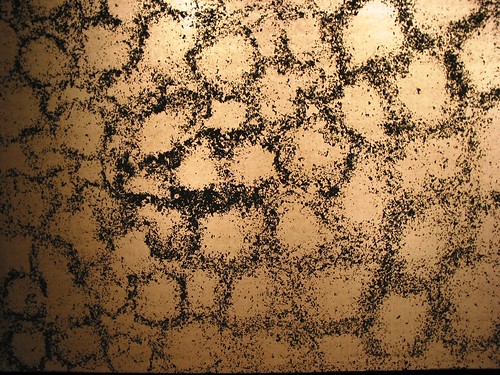
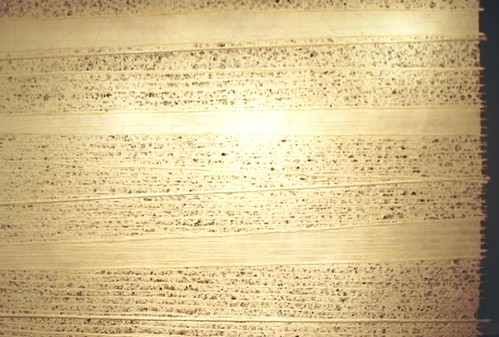
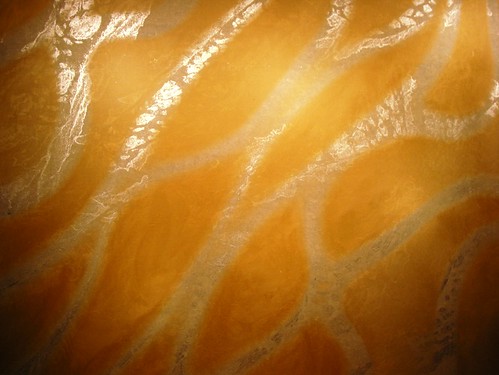
Situated in a narrow old Kyoto neighborhood is the studio and showroom of one of Japan's most successful contemporary artists, Eriko Horiki. As each distinctly different, 10 foot long sample of her washi art after another is rolled out on ceiling tracks, the paper reveals its beauty: thin fibers creating delicate swirls around tiny bits of mulberry bark, long coarse strips of bark floating dramatically in what looks like churning whirlpools. Washi's color and texture are enhanced by light, and as Horiki slowly shifts the light source from the front to the back of the piece, the fibers within the paper become illuminated and then disappear, creating an ethereal experience for the viewer.


It takes ten skilled workers to produce a piece of Horiki's large format washi -- five artists and five craftsmen in an elaborate, almost choreographed operation. Horiki explains, "Washi can be created to specifically match any architectural need or function." However, there is an additional, unknown element that always finds its way into this art. "Because the paper involves natural bark fibers floating in water, we cannot completely control the outcome of the finished work. We have come to accept nature as a part of the collaborative process."
Horiki came from neither an art nor a craft background. After working for four years in banking, she moved to the accounting department of a company that specialized in developing products made from washi. She then came into contact with professional paper artisans in the washi-making town of Imadate in Fukui Prefecture. Becoming completely captivated by the workmanship of these craftsmen, she decided to devote herself to this paper production to help ensure that washi making skills handed down over 1500 years would be passed on to the next generation. Today, you will find her works provocatively installed as walls, room dividers, ceilings and windows in restaurants, hotel lobbies, and public spaces throughout Japan, bringing drama and exceptional beauty to the surroundings.
"I was a complete amateur when I jumped into this business," Horiki confesses. "If I had had more experience, I would only have seen impossibility in the task I had chosen." But through visits to public buildings, study of their design and decoration, and sheer perseverance, her studio was born.
Public places are plagued with cigarette smoke, direct sunlight and human beings with curious fingers. Washi can tear, burn, lose color, get dirty and contract or expand, making it difficult to use as a building material. It takes as much effort to protect the washi as it does to design and create it. But Horiki likes challenges. "I have always believed that, no matter how seemingly impossible a project, if it is an idea which came from a human mind, then a human mind can come up with a solution. I must go forward and do it."
Horiki found the solutions to many potential problems through technology, sandwiching her washi in glass when necessary, and allowing the stunningly warm, soft and radiant paper to thrive in the harshest environments. But since standard glass creates distracting reflections, her team had to painstakingly innovate ways to prevent glare, all while following safety laws that obliged them to use the same shatterproof glass as in car windshields. In addition to being artists, her crew must also be scientists.

One of Horiki's most exciting projects was a collaboration with cellist Yo Yo Ma, a 46 foot long by 13 foot high single piece of washi that is the stage backdrop for his "Silk Road" concert tour, which debuted at Carnegie Hall. "Yo Yo Ma first found out about us when he saw our work here in Kyoto," Horiki explains. "We talked about the traditional and innovative aspects of washi, and new possibilities in music and stage decoration."


"The Silk Road symbolizes the connection between time and place," Horiki says, and her team worked for two months to create a set embodying the essence of the Silk Road, the ancient Asian highway which connected peoples of many cultures from east to west. For some 20 minutes during the show, the entire stage environment slowly changed as Horiki's work was illuminated through lighting techniques corresponding to the inflection of the music.
Committed to excellence, energized by challenges, talented and hard working, Eriko Horiki is an inspiring example of how traditional Japanese crafts are being reinvented as one-of-a-kind works of art for the 21st century.


Yet to a Westerner her pieces might not even look Japanese, but amazingly international. Horiki sees this, in part, as the flow of ideas enabled by our contemporary world: "People meet and are influenced by each other, people are influenced by previous eras, people from different countries influence each other. From all of this interchange comes the birth of a new culture."


http://www.huffingtonpost.com/steve-beimel/meetings-with-remarkable-_2_b_875348.html

Search This Blog

Blog Archive