Always fascinated by ghost towns and cities (did you know that there was a Sodom and Gomorrah in Ontario, Canada about 80 kilometers west of Toronto?), I thought I would see if Japan had something similar.
Hashima Island (端島) consists of 15-acres of land, and is one of 505 uninhabited islands in
Nagasaki-ken (Nagasaki Prefecture). Situated about 18.5 kilometers southewest off the port of
Nagasaki, it was populated between 1887 and 1974 as a coal mining facility.
Known also as
Gunkanjima,
Gunkanshima (both of which mean Battleship Island), it is also called Ghost Island nowadays because it is abandoned.
Mitsubishi Material (A segment of the Mistubishi company who are the automobile manufacturer who once manufactured engines for the WWII Japanese
Zero fighter planes), purchased the island in 1890 to dig out coal from undersea mines which led to the industrialization of the country.
 |
| Concrete buildings of Hashima. |
They built Japan's first large concrete buildings - between four and seven stories high - as a block of apartments back in 1916 to house the growing number of workers. It was made of concrete to help add a layer of protection against strong typhoons.
There are currently 10 concrete buildings placed alongside the coastline of Hashima. There is also a very strong sea wall surrounding the island to protect it from typhoons and tsunami.
It should also be noted that a lot of the workers at the mine were forcibly recruited from other parts of Asia, notably China and Korea.
I've said it before, but Japan was pretty bad-ass in the old days, which is why the rest of Asia still ends to look at the country with hate and distrust - despite the damage done generations ago. Long memories, you know...combined with Japan's failures to accept culpability.
As one of the most productive coal mines for Japan during WWII, Hashima was mined, amongst other nationalities, by 500 Koreans during 1939 - 1945.
 |
| Collapsing stairway into Hell, Hashima. |
“The Island was a living hell. You could not dare to escape it because of high breakwaters and huge waves. By the end of the war, Koreans were involved in dangerous work and they were often vulnerable to violence of mine supervisors,” recalled Park Jun-gu, 87, a victim of the mine.
According to a recently discovered document, 122 Koreans died in the Hashima mines from cranial damage, drowning and crushing. They were buried or cremated on the island.
After World War II, the island saw an improvement in life with modern luxuries provided for the workers (no longer prisoners). Televisions, radios and a movie theater were placed on Hashima - all maintained by the island’s employee-residents.
 |
| Have a seat and watch the show. |
In 1959, the population of the entire island peaked at 5,259 people (a population density of 835 people per hectare or 83,500 people/km
2 or 216,264 people per square mile), or 1,391 per hectare (139,100 people/km
2) for the residential district.
By the time the 1960s rolled around, oil and gas began to replace coal in Japan, forcing the closure of many coal mines, eventually leading to Mitsubishi officially closing the Hashima mine in 1974.
 |
| Seawall and concrete living quarters, Hashima. |
Mistubishi voluntarily gave Hashima to the town of
Takashima in 2002, which itself was merged into part of
Nagasaki-shi (Nagasaki City) in 2005. That means Hashima is part of
Nagasaki now.
Back in 2007,
Nagasaki set about re-opening Hashima as a tourist destination - though mindful that not all of the buildings were safe for visitors. It was also attempting to put the island and its Japan-first concrete buildings on the
UNESCO World Cultural Heritage List.
Needless to say, neither plan was welcomed by
Truth Commission on Forced Labor under the Japanese Colonial Rule of South Korea.
 |
| Hashima pre-1974 boasted a school for its workers' kids. |
The South Korean group criticized the
Nagasaki attempt to develop Hashima as a tourist destination while covering up their crimes against Koreans.
Lee Jae-cheol, spokesperson of the commission, says: “Nagasaki’s attempt to put Hashima Island where Koreans suffered so much on the World Heritage List is in line with the Japanese government’s attitude of whitewashing its history. We will take appropriate actions in relation to Nagasaki’s moves.”
Because of the architecture, Hashima has gained some international attention not only as one of the modern international heritages in the region, but also as the housing complex remnants in the years from
Taishō era to
Shōwa era.
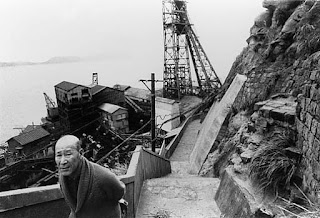 |
| Hashima was not the most picturesque place to live even in pre-1974. |
The main problem regarding the re-opening of the island for tourism is that since being abandoned in 1974, the island has not been maintained and several buildings have already collapsed. Other existing buildings could still collapse, though some collapsed exterior walls have been restored with concrete. It was evened mentioned in the premier season (2009) of the
History Channel's
Life After People television show noting how after only 35 years, buildings would fall into absolute decay.
To fully make all of the buildings safe for human visitors, quite obviously a large amount of money and Korean laborers would required, neither of which appears to be forthcoming.
Still, travel to Hashima was re-opened on April 22, 2009 after 35 years of closure. It is not currently on the
UNESCO World Cultural Heritage List.
Files by Andrew Joseph


 Posts
Posts

