Showing posts with label Law. Show all posts

Shareholders Sue TEPCO For $67.4 Billion

Now that's a big effing lawsuit!

Japan - It's A Wonderful Rife isn't sure if the timing of all of this is coincidental or not, what with the one year anniversary of the Tohoku earthquake coming up on March 11, but the story below does smack of greed.

Let's take a brief look.

TEPCO (Tokyo Electric Power Company) Inc.
- the private firm that owns and operates the Fukushima-ken Dai-ichi nuclear power generating plant - is being sued by 42 shareholders for ¥5.5 trillion (~Cdn/US $67 billion).

Let's look at that number for a second... wow. That is $1,595,238,095.24 (¥130,050,387,316) each. One and a half BILLION effing dollars. For each shareholder suing.

Granted 80% would go to the lawyers, but what greed!

The Dai-ichi plant, after a 9.0 Magnitude earthquake caused a massive tsunami to knock out power to it, nearly had three nuclear meltdowns over the ensuing weeks - arguably the worst nuclear accident in the past 25 years, causing TEPCO to incur huge costs to try and right the problem, clean-up, decommission the plant and provide slow-giving compensation to people and businesses affected by problems.

The filed lawsuit points to 27 specific current and former TEPCO directors, saying they ignored multiple warnings of a possible tsunami, and by doing so failed to adequately prepare for the likelihood of a disaster. And that is what well-dressed lawyers for the shareholders said in a released statement on March 5, 2012.

While this blog admires their greed (how do I get me some?), this lawsuit against TEPCO is akin to kicking a dog when it's already dead and run over on the street.

Yes... TEPCO will no longer be pumping electrical power out for the people of Japan because the plant is now ruined. That means shareholders won't be making any money.

Hell... I'd be pissed, too... but $1.5 billion pissed? I'm pissed off a lot lately and I still can't see myself being so bloody angry or greedy to even contemplate a number like this. Wow.

Just to give you a ,peek on what shareholders might be thinking: did you know that by March 15, four days after the 2011 tsunami et al, TEPCO shares dropped more than 62 per cent of its value? Owtch! Of course, two days after that, TEPCO stock was up 14.9 per cent after hopes were raised that the nuclear problem would be too bad at all - that everything would be contained. Needles to say, TEPCO stock has been up and down (mostly down) the entire year.

What? Did you think the people doing the suing were thinking about the Japanese people in the Tohoku region who have lost family, friends, life, business, livelihood, their way? Nah. But $1.5 billion should assuage the guilt.

By Andrew Joseph
 

Bad Kitty!


Perhaps in an effort to stop that infernal caterwauling - though we at Japan - It's A Wonderful Rife doubt that is a concern - cat cafes in Tokyo are being spayed with a curfew.

Thanks to a revision of the existing Japanese Animal Protection Law that will begin on June 1, 2012, the public display of dogs and cats will not be allowed past 8PM, meaning cat cafes will have to lock its pet door early.

This is of some concern for cat cafe owners, as they make their money on the backs of cats Japanese workers often only leave work at around 8PM thanks to the fact they are afraid to leave any earlier. IN Japan, underlings lose face if they leave work before their boss - which can be problematic, as bosses often take a six-hour-nap starting at 2PM. The only way employees can leave early (before 8PM), is if the boss is off to meet his girlfriend early so his wife isn't too suspicious (She knows).

It's the post-work crush of people with cat scratch fever looking for pussy cat love that the cafes depend on - and that post-work crush may not even have started by 8PM, unlike the lazy Canadians and Americans who dare only work 9 to 5.

So... without an outlet to play with a purr pal, how will the over-worked young Japanese professional handle his or her stress? 

Look... this blog understands the need to not 'over-work' the animals... but these animals already are well taken care of... aside from the love and affection they are given by the paying customer (god! It's like visiting a hooker!) (So I hear), the cats at the cat cafe do shift work, meaning they only work for a few hours at a time before they have to be placed in another room away from customers so that they can relax, take a toilet break, stretch, yawn, lick themselves and perhaps choke up a furball. It's a good life, but I am unsure how much money they make.

What I'm getting at, is that at least the cats at the cat cafes seem to be well-looked after - and perhaps limiting the cats and their cafes to a mere 8PM is a miscarriage of law-making, and isn't fair to the cafe owners or their patrons.

Besides... the cats I have had (and have) tend to be more active at night... just saying, is all....

Does this also mean that cats and dogs appearing on television (live television) are limited to appearances before 8PM?

We'll assume the new law does not affect working dogs... the those working with a visually-impaired person or a drug-sniffing dog at the airport, but will affect dog shows and other posing events... perhaps even television commercials! Oh my dog! This revised law could takeseafood platters out of the mouthes of kitties! Oh the inhumanity!

Okay... I've had enough. I love my cat, but I am more of a dog person.

By Andrew Joseph

Japan's Death Row - A Look Inside

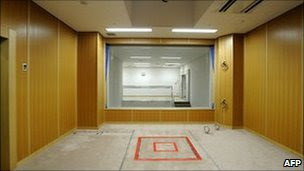
View of a death chamber, Tokyo, Japan.
Hi there. Many of you know I have a fascination for the serial killer and other murderers. No, I don't like what they have done or want to meet one... well, not really. But, I am fascinated at how one human being can murder another human being, let alone commit multiple murders.

I suppose I am intrigued by the human mind and all of its depravities. Like I said, it doesn't mean I like or respect these warped individuals... only that I am curious as to what makes them tick..

Having said that, I am also curious about the manner of their incarceration, or in the case of Japan, the manner of their execution. For example, Japan hangs those it deems unfit or unworthy of rehabilitation.

I've written about all of Japan's serial killers HERE, and about one its most infamous rape gangs HERE.

I've learned as much as possible about what drives them - great on the drive, but very little actual information on why or what gives them this feeling of entitlement.

But, what about how these prisoners are executed? Back on August 27, 2010, members of Japan's media were, for the first time ever given a peek into the execution chamber of a Tokyo jail.

First... some background. I've always found this odd, but when trying to get the date of death of someone executed, there are often few definitive answers. That is because Japan tries to avoid the media circus as much as possible.

To accomplish that, the death row prisoners are not told of the their date of execution until the last possible minute, and their relatives are only told after the actual hanging. In fact, anywhere between two or three executions are carried out at a time.


This practice of secrecy has been condemned by many in the international community citing that the failure to give advanced notice of an execution contravenes Articles 2, 7 and 10 of the International Covenant on Civil and Human Rights according to the United Nations Human Rights Committee.


Consider also that the average time (according to best guesses of some reports on Japan's justice system) a prisoner who has received the death penalty actually spends awaiting the actual execution is seven years and 11 months.    

The oldest prisoner was said to be Ishida Tomizo (surname first), who is 86 as of December 2007. He was convicted for rape and double murder in the early 1970s and sentenced to death in 1980. To be honest, I could find no information on the Internet as to whether or not his sentence was executed, whether he died naturally, or if he is still awaiting his execution. 

For further reference, Hakamada Iwao (袴田 巖 , born on March 10, 1936) is a former Japanese professional boxer, who was sentenced to death for a June 10, 1966 mass murder of four people. He was sentenced to death on September 11, 1968. as of 2009 he had been in prison for 42 years, the longest imprisonment among condemned prisoners in Japan. Part of the problem may be that he may have been falsely charged, as the physical evidence was changed from pajamas to clothes - and the clothes did not fit him. I could not find a death date for him, so I can only assume he is still alive, or his death notice has been withheld.

Apparently the Minister of Justice may refuse to sign a death warrant if they personally suspect that the conviction is not secure.

A Look Inside
Nowadays, local television stations broadcast footage showing the room where death row inmates are hanged. 
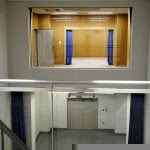
Witnesses can view from the top or bottom.

 In Japan, where criminal trials have a 99 per cent conviction rate (take that Perry Mason!), many in Japan's public office oppose the death penalty, official surveys note that there is strong public support in favor of it, at well over 80 per cent. 
There are currently seven execution facilities in Japan. Hanging is the form of execution, with the prisoner dropping through a trapdoor with a carefully measured noose about the neck that will break the neck instantly as the trap door is opened.  

During the recent 30-minute tour, the media was shown the red square on the floor where a convict stands with a noose around their neck before the trapdoor opens beneath them (see first photo above). The room behind the glass (in the photo to the left) shows a viewing chamber for witnesses.

Buddhist Altar
The media was also shown a room with a Buddhist altar where condemned prisoners can meet a religious representative (below right).

"There was the smell of incense. The impression was that of sterile objects in a clean, carpeted room," says a reporter from NTV.

Footage also showed the room where three staff each push a button which releases the trapdoor - although none of the three actually knows which one's button causes the door to open.

The noose was not shown.

The noose is held in place by this coupling.
As of December 2011, a total of 107 inmates remain on death row in Japan.


According  to Amnesty International, prisoners on the death penalty live under "a harsh regime and in solitary confinement with the ever-present fear of execution. They never know if each day will be their last."

Some reports in the Japanese media have described how the prisoners are kept in "toilet-sized cells".  Prisoners are not allowed to talk with one another.
 
However, it should be noted that the death row prisoners are not kept in prisons - they await execution at a detention center. Surprisingly (or not), these death row inmates have fewer rights than other prisoners, with reports stating that death row prisoners only get two two periods of exercise a week - three in the summer - and are not allowed to even do limited exercise within their cells - that they must remain seated. 

However, it varies from detention center to detention center, depending on the rules set forth by the facility director.

Up until a few years ago, the names of the executed were not released (hence my problem in finding accurate death dates for a previous blog).

Former Japanese Justice Minister Hatoyama Kunio (surname first) said it was done "to gain the understanding of the bereaved families of the victims and the public over the appropriateness of executions".

Amnesty International at the time acknowledged that the change in policy over the naming of those executed represents a shift towards more openness - but it adds that there is a long way to go.

Japan, percentage-wise has a far smaller proportion of its citizens in jail than the United Kingdom or the United States. 

But critics of Japan's justice system are concerned about its reliance on confessions, with allegations that confessions are often coerced from suspects by police and prosecutors. Those who oppose the death penalty here say there are not enough safeguards to prevent innocent people being put to death.

International human rights standards prohibit the imposition of the death penalty on the mentally ill. Amnesty International says that the conditions - and length of their detention - that death penalty prisoners endure is making them mentally unwell and delusional.  

According to Japan's code of criminal procedure, if a person condemned to death is in a state of insanity, the execution shall be stayed by the justice minister.

But, Amnesty International says that executions of inmates who exhibit signs of mental illness - caused by the extreme conditions and the sheer length of their detention - continue. 

Files compiled by Andrew Joseph

Schoolgirl Fined For Phoning And Cycling

I'm unsure if the following story is a good thing or a bad thing. 

Back on July 3, 2011, a 15-year-old high school girl became the first person in Japan to be fined for using a cell phone while operating a bicycle.

This is good on a couple of levels: she  can now concentrate all of her attention on looking where she is going and can better watch out for Japan's wacky drivers who tend to be more interested in bowing to the driver of every car they pass rather than the actual rules of the road.

Regardless... the unnamed girl (she is 15!) was given a ticket under a Kanagawa Prefectural government ordinance that began on May 1, 2011 that makes it illegal for cyclists to engage in dangerous activities while riding, like using  a cell phone or listening to music through headphones (how can you hear emergency vehicles or cars honking at you as you swerve all over the road while trying to keep the beat to Shonen Knife - an awesome band - you just can't!).

A police officer using a megaphone ordered the schoolgirl four times to stop looking at her phone as she rode through the streets of Hiratsuka-shi (Hiratsuka City) in Kanegawa-ken (Kanegawa Prefecture), but she ignored him (perhaps she also had headphones on), so he stopped her and gave the teen a ticket.

The girl faces a fine of up to ¥50,000 yen (~ Cdn/US $650), pretty much admitted complete ignorance of the new law when she told police: “I thought I’d be all right if I was only riding a bicycle.”

Bakayaro! (Stupid idiot!) That's the crux of the law! Dangerous stuff on a bicycle.

On the downside, it also means that had this law been in effect back when I was still living in Japan, and had I been living in Kanegawa-ken, I could have been fined for doing wheelies, carrying excessive amounts of gaijin groceries, doubling my girlfriend, having sex with my girlfriend... yes, it is possible to have sex on a bicycle... but owing to the intense amount of pumping involved, it does tire one out.

Oh... and look at the photo above... does riding a bicycle with an umbrella look dangerous? Aside from the possibility it slightly obscures ones vision, or that the wind could destabilize you, your humble author (the world's most humble author) was schmucked by a car while he used an umbrella to keep the typhoon from soaking him more than he was already soaked.

While I did know the 100-kilometer-an-hour winds could take the umbrella away from me and toss me into a rice field in Oz, I never had a problem with it (he's so big and strong). I was hit because a Japanese driver in a white car decided his car had the right-of-way at a three-way stop - regardless if the bicycle rider had already stopped and was more than half-way across the street. Idiot.  While I went over his hood and lay unmoving (on purpose) on the puddle-filled road, I waited about 30 seconds while he slowly looked for an umbrella in his car before venturing to see if he had killed the local gaijin (foreigner) in Ohtawara-shi, Tochigi-ken.

Unfortunately, he didn't.

So... Japan - It's A Wonderful Rife is now sure of its opinion, and applauds the new law that saves lives so the bicycle rider can better protect themselves from the bad drivers of Japan.
   

Files by Andrew Joseph

New Rules Could Halt Raw Beef Dishes

Japan's Ministry of Health, Labor and Welfare (MHLW) has made tougher regulations on the use of raw meats - which may make the sale of such products impossible in restaurants.

Changes were brought about after four people died of food poisoning this year after eating raw beef at the Food Forus company's Yakiniku-zakaya Ebisu restaurant chain.

"Many restaurants started offering raw beef when it became popular, even though there was a great danger that the meat contained toxins. Safety must take precedence over a drop in supplies or a price increase," says an un-named senior ministry official.

The Ministry's revised rules state that meatpackers must heat a section of raw meat at least one centimeter (0.4 inches) deep from the surface at 60 degrees Celsius (140 F) for two minutes or more to sterilize it before shipping to restaurants.

Restaurants are then required to trim away the meat's cooked surface to expose the raw meat before preparing any raw meat dishes.

The popular dishes this new rule encompasses are: yukke (a Korean-style tartar steak with a raw egg), beef sashimi (thinly sliced raw beef), beef tataki (pounded beef) and steak tartar.

Penalties for not following this regulation are stiff, with serious in fractions possibly causing the closure of the business, imprisonment up to two years or a ¥2-million (~ CDn/US $27,200) fine.

Under previous regulations, restaurants were allowed to serve raw beef to customers by just trimming the surface of the meat. However, even if these rules were violated, no one was punished.

Meatpackers and restauranteers fear this new rule will affect pricing of the useable raw meat, as larger swathes of raw beef will be trimmed away from every cut. Prior to this new rule, after trimming away the raw beef from a cut, restauranteers could expect a 20 per cent loss. But now with even more meat to be trimmed, they expect the portions of meat that can be served may go down to 30 to 40 per cent of the original size.

And, just because it made the law, don't expect ministry officials to sit around chewing the cud. It will be active in ensuring its rules are followed, with further plans to add to the regulations next October 2012 to oblige local governments to issue permits to restaurants serving raw meat.

Files compiled by Andrew Joseph

Suicide From Overwork Pays Off

Okay... perhaps that headline is a tad unfair.... but, according to a Japan Times article, Japan's Supreme Court has decided to dismiss the appeals of two companies regarding the suicide of a young worker. 
 
Judgement for the plaintiff says the Nikon Corporation (yes, that camera company) and a temp agency located in Nagoya must pay compensatory damages for the 1999 death of Uendan Yuji (surname first), a 23-year-old man who killed himself due to work-induced depression.
Both companies will pay ¥70-million (~ US/Cdn $954,000) to Uendan's mother. Uendan killed himself while working at a Nikon plant in Saitama-ken (Saitama Prefecture), placed there by the temp agency.
Two years ago in 2009, the Tokyo High Court ruled that Uendan committed suicide due to depression caused by overwork and that both the temp agency and the company where he worked failed to exercise due care. Uendan was providing product inspection and working long and irregular hours in a windowless room with no space to relax.
 
Editors Note: I believe that Uendon had other mental health issues. Globally, how many people work every day in an environment similar to Uendon's but do not kill themselves? Thousands? Millions? How many people hate waking up in the morning because they dread going into work? How many people worry that they may not have a job tomorrow? We don't kill ourselves.
 
I once worked a job with 11 gorgeous women. Not bad, right? Well... six of them were bitches from Hell who hated the fact that their female boss had actually hired a man (me) to invade their work environment.The room was 15 feet x 15 feet, and housed all 12 of us somehow. Windows - sure... just nowhere near me. What was incredible interesting, however was how all of the women altered their menstruation cycle to the alpha woman... so when it was that time of the month, I was completely screwed. I hated waking up and going to work. I hated being there. And, I hated leaving work knowing I had to come back. The pay sucked too, as did the work I was asked to perform. It was a stressful job and I hated darn near every single second of it while I was there... and yet, I did not even entertain the notion of killing myself. I may have entertained the notion of offing a few of the co-workers, but  the important thing is that I in no way acted upon these dark thoughts. But Uendon did. Can't handle the job? Simply quit or change jobs. That's what I did over six years ago (to my current position as a magazine writer)! Uendon was a temporary employee hired through a temp agency! Quit. Get a new temp agency to help you find a job. No... this guy already had issues percolating in his brain. 
 
I think the courts screwed up here. Is a company supposed to ensure you are mentally competent? I thought perhaps only to the degree that one can do their job. But this ruling, and the one from 2009, implies that companies really need to take better care of their employees... how? Would windows have saved Uendon from suicide? Not working off hours? He was a temporary employee. He had the choice to work those hours or not - to seek out another job where the work wasn't going to kill him. 
 
It is my opinion that societies all over the world do not do enough for people with mental health issues. Canada does a good job, but it could be better. While those who seek it out can get the government-sponsored medicines they need and the psycho health care... but that's only when they realize and accept that there is a problem. I know many people who suffer with depression, social anxiety disorders, manic-depression, schizophrenia and more. Some are able to work and function 'normally' thanks to medication. Others get life-time financial aid when they can't work.  
 
Does Japan have proper mental health agencies for people? They certainly have provided some aid for kids who lost a parent or parents after the March 11, 2011 earthquake and tsunami disasters (story HERE).  There's also the comfort doll for the elderly: HERE
 
I'd love to hear from Mike (in Tokyo) Rogers about this topic... or from any of you dear readers about what mental health coverage your country provides... or covers up. 
 
Cheers
Andrew (It's 3AM??!!) Joseph
PS: And no... I do not have any mental health issues... in case you though I did, which would explain so much.

Search This Blog

Blog Archive