Showing posts with label japanese. Show all posts

Writing Thank-you In Japanese

Someone has been visiting my blog a few times searching on how one would write the word "thank-you' in Kanji - the Chinese-style alphabet that Japan uses along with the Hiragana and Katakana alphabets.

Sorry. The Japanese word(s) for 'Thank-you' is Domo arigato, and is written in Hiragana - not in Kanji.

It looks like this:

どうもありがとう 

Sorry... but I hope this helps!

Cheers, 
Andrew Joseph 

Unique 'Degas and the Art of Japan' Exhibition in Final Month at Reading Public Museum

READING, Pa., Nov. 26 /PRNewswire-USNewswire/ -- The works of Edgar Degas were deeply influenced by Japanese art, yet surprisingly, there has never been an exhibition devoted to this subject...until now. Degas and the Art of Japan at the Reading Public Museum, on display now through Sunday, December 30, 2007, is the first exhibition of its kind to bring together a variety of works by Degas with an illuminating selection of Japanese objects, including a work actually owned by Degas and many images he knew and admired. Displayed side-by-side with the art of the famous Impressionist, these dynamic scenes of Japanese life are revealed as the inspiration for many of Degas' most inventive pictures of dancers, cabaret singers, laundresses and the French countryside.

This unique exhibition of over 60 works, organized by the Reading Public Museum, includes works by Degas borrowed from museums and private collections in the United States, Canada and Europe -- as well as three extraordinary pictures by Degas belonging to the Reading Public Museum's permanent collection. The Degas works are complemented by Japanese objects from major national institutions, as well as from the Museum's own extensive collection.

As the exhibition progresses, Degas' debt to Japanese art comes alive in portraits, pictures of women bathing and combing their hair, scenes of theater-goers and ladies of leisure, and in fans... one decorated by the artist himself. Previously unidentified links between Degas' pictures of laundresses and their Ukiyo-e prototypes are brought to light, as will other little-known aspects of the French artist's sustained engagement with the art of Japan.

The exhibition is accompanied by a fully-illustrated color catalogue written by exhibition curators Jill DeVonyar and Richard Kendall, who also organized the groundbreaking exhibition Degas and the Dance in 2002-3 at the Philadelphia Museum of Art.

This exhibition is underwritten by the Marlin and Ginger Miller Exhibition Endowment and Sovereign Bank. Additional grants have been made by the Pennsylvania Historical and Museum Commission, the Jerlyn Foundation, Yuasa Battery, Inc., and the Pennsylvania Council on the Arts.

The Reading Public Museum is located at 500 Museum Road, Reading, PA. Web: http://www.readingpublicmuseum.org/.
READING PUBLIC MUSEUM

http://www.earthtimes.org/articles/show/news_press_release,229696.shtml

Joyful paintings in "Japan Envisions the West"


A group of maps sets the stage for Part I of "Japan Envisions the West: 16th-19th Century Japanese Art from the Kobe City Museum." They demonstrate the distortions of scale and location lodged in people's minds when European interactions with Japan began in the late 16th century. The collection of painted screens and scrolls, woodblock prints and assorted decorative arts highlights the early cultural exchange between Japan and the West and celebrates the 50th anniversary of the sister-city agreement between Kobe and Seattle.

A lovely woodblock print by the great 19th-century master Hokusai stands as a perfect emblem of the show. "Two Ladies Looking through a Telescope," from a series called "Fanciful Presentation of Seven Useless Habits," shows traditional Japanese women in their kimonos and manufactured hairdos mesmerized by the magic of an imported telescope. That image may seem incongruous, but stranger things crop up.

From distortions of place, "Japan" goes on to document the odd (and occasionally monstrous) cultural hybrids born when European painting and decorative styles began mingling with their Eastern counterparts. Japanese artists dabbled in the strange medium of oil paint and pondered such curious Western inventions as hot-air balloons and locomotives, and the unfathomable behavior of a Dutch man and wife who walk together arm in arm down the street. And what about those weirdly assembled white faces, with their pale hair and curly beards? The net effect of the artworks is a floating sense of dislocation. Where are we?

A 17th-century "Comptoir with Landscape Design" survives as a kind of cultural battle-of-the-bands that takes furniture design to new heights of ostentation. The Japanese-made lacquered-wood chest begins sanely with a spare and lovely gold and black landscape image. But that gets gussied up with a regiment of golden metal hinges. Then some Dutch craftsman apparently got hold of the piece and added a carved wooden stand so over-the-top with curves, flowers, frills and gold that the whole thing ends up resembling Cinderella's fairytale carriage.

What's on display now is the first segment of a two-part show. It ends Nov. 25. Beginning Nov. 30, SAM will host a two-day international symposium with presentations by Dutch, Japanese and American scholars. On Dec. 1, Part II of the exhibition will open to the public.

Beckoning from the adjacent galleries is the joyful exhibition "Gaylen Hansen: Three Decades of Painting," spotlighting more than 30 of Hansen's big, exuberantly colored, tacked-to-the-wall canvases. The casual presentation, which moves chronologically from the 1970s to the present, is part of their charm.

Hansen, who has lived in Palouse, Wash., since 1957, is one of the state's most admired and original painters. In a recent interview with The Times, Hansen talked about his early interest in illustrated books and how a copy of the novel "Don Quixote" made a big impression on him as a boy. It's nice to keep that famously misguided Spanish adventurer in mind as you wander through Hansen's show. Kernal Bentleg, a recurring character, stands as a sort of alter ego for the artist and roams the Palouse countryside on horseback in very quixotic way. There's a mythological undertow to the work even at its most humorous. The Kernal often finds himself face to face with the overwhelming force of nature, embodied in plagues of grasshoppers the size of porpoises, or a buffalo built like a tank.

Even Hansen's recent simple still lifes resonate with some kind of subversive meaning. One of my favorites is the 2003 "Yellow Jar and Glove," which is just that. A yellow jar with a dark lid standing shoulder to hip with a nearly black work glove. Just a jar and a glove, in a pool of yellow light with a pale shadow extending straight right, and a darker yellow line, like an escaped part of the painted frame, underscoring the image — so tense and unfathomable, so hard to turn away from.

Sheila Farr: sfarr@seattletimes.com
Copyright © 2007 The Seattle Times Company

Japanese Education Systems

When Japan opened herself to the world in 1868, one of the government's high priority was catching up with Western standards in science and education. The Japanese education system was reformed mainly according to the German and French model which experts regarded as most suitable and advantageous.

After the second world war, the Americans reformed the Japanese education system after their own which consists of six years of elementary school, each three years of junior and senior high school and four years of university or two years of junior college.
Compulsory education includes elementary school and junior high school. Over 90% of all students also graduate from high school and over 40% from university or junior college. At universities the percentage of male students is higher than that of female students while the opposite is the case at junior colleges. The number of graduate university students is relatively low.

The Japanese school year starts in April and consists of three terms, separated by short holidays in spring and winter, and a one month long summer break.

A characteristic of the Japanese school system are entrance exams, and with them a high competitiveness among students. Most high schools, universities, as well as a few private junior high schools and elementary schools require applicants to write entrance exams. In order to pass entrance exams to the best institutions, many students attend special preparation schools (juku) besides regular classes, or for one to two years between high school and university (yobiko).
The most prestigious universities are the national University of Tokyo and University of Kyoto, followed by the best private universities.

http://www.japan-guide.com/e/e2150.html

Growing demand for contemporary Southeast Asian art

By Valarie Tan, Channel NewsAsia Posted: 24 August 2007 2022 hrs

SINGAPORE : The market for contemporary Southeast Asian art is growing rapidly.

One Singapore gallery says prices for well-known art works have gone up by about 150 percent over the last three years.

The bulk of the buyers are from Asia.

Malaysian artist Ahmad Zakii Anwar has gained popularity over the last decade due to his artwork.

Collectors of his artwork come from all over the world.

But a majority of them are Asians from places such as Thailand, Hong Kong, Singapore and Japan.

Just this year, one of his paintings went under the hammer for US$43,000 - a personal world record for the artist.

Irene Lee, Director, Singapore Tyler Print Institute, said, "Some works that were sold for 3, 4 thousand dollars could now be auctioned for easily US$25,000 to US$30,000. So I think that's a very impressive progress in the last 2-3 years."

She added, "It's an influence of how Asian contemporary art has captured a lot of imagination and interest from collectors around the world."

But numbers mean little to Johor-based Mr Zakii who turned professional about 15 years ago.

The 51-year-old former graphic artist said he is more inspired by the process of making art.

He said, "I'm not a collector. I'm not a dealer. The only thing I can do is make good art. To make the best art that I can, that I possibly can. And if that art moves the market, moves the standard of Southeast Asian contemporary art, then I'm happy with that."

Mr Zakii is currently holding a solo exhibition of his works at the Singapore Tyler Print Institute.

He is the first Malaysian artist to be invited for the institute's Visiting Artists Programme.

The exhibition runs till September 8. - CNA/ms

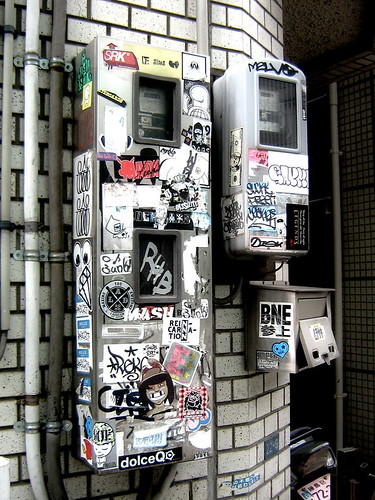
Street Art in Japan


Various pictures of art in the streets of Japan

East Bay art centers celebrate ties to Japan

ROBERT TAYLOR: FINE ARTS
Contra Costa Times
Article Launched: 07/05/2007 03:03:30 AM PDT


BERKELEY IS marking the 40th anniversary of its sister-city relationship with Sakai, Japan, a port city near Osaka. One result of that relationship is the Berkeley Bridge Artists, a group that promotes cultural exchange and is sponsoring three exhibits to the East Bay this summer.
The most wide-ranging exhibit is at the Richmond Art Center and is titled "Moshi Moshi!" after the all-purpose telephone greeting in Japan.

The exhibit is not as lively as its title, but it does display nearly 100 works by 30 Japanese and 20 American artists. The intention is to show how they influence each other, although international influences could play a part as well.

What "Moshi Moshi!" does best is show a variety of art from one region in Japan -- paintings, drawings, prints, calligraphy, photographs and sculpture. Not all by one artist, or all in one medium.

Several of the artists have earned the status of "living national treasure" in Japan, but the exhibit doesn't strive to be reverential. The Richmond Art Center isn't the place for dramatic spotlights and hushed tones.

The ceramics and sculpture, out in the midst of the gallery, are a particular pleasure. One of Toyomitsu Hondayama's rough-surfaced ceramic pieces, with a twisted shape and striated curves, might be an ancient relic dug out of the ground or discovered in the ocean. He also displays twin pots shaped like a child's toy boats, with their top surfaces grooved like raked gravel in a temple courtyard.

There's a wide range of styles among the paintings, from some that look like exploding galaxies to Aki Nakai's charming, thoughtful portraits of women, each with her head resting on one hand. As the gallery exhibitions manager pointed out, the paintings look as if they've borrowed inspiration from Mary Cassatt -- who borrowed, herself, from Japanese art.

Most of the paintings are abstract to some extent, among them Mitsuru Fukui's pair of landscapes that look like worn and scraped blackboards with the scattered remains of rocks and sticks. Kyoko Suekane's trio of "Under Sky" landscapes are just as mysterious, but in contrast, they're painted and scraped on silver foil paper, with the foreground looking like immense ice floes carved by canals.

YOU CAN'T HELP smiling when you walk into the NIAD gallery in Richmond and see the colorful and imaginative works produced at this center for art and disabilities.
That's especially true now with the "Summer of Love" show. The entry wall painted a vivid purple for the dipole of Metrius Englin's amusing portrait of a nude lounging on a purple-print couch. Behind her is a painting-within-the painting, a still-life depicting a bowl of fruit against another purple background. And to the right of Englin's portrait is a chunky ceramic sculpture with a gleaming blue glaze by Susan Wise.

The canny arrangement is by Ted Cohen, who has given Oakland Museum exhibits a dramatic edge for many years.

The NIAD gallery feels unusually spacious for this show, with the additional punch of a rear wall painted orange to display a hanging, multi-textured yarn sculpture by Vincente Villanueva. Another hanging sculpture of braided rope, by Lacee King, floats in the middle of the room.
Other impressive sculpted and crafted works include Dorrie Reid's "Tsunami," built mostly from carpenter's shims, painted blue, aqua and green and dotted with black and orange. Another is Dorothy Porter's delightful little figure made of striped knit fabric like socks, with a pair of rabbitlike ears and three button "eyes."

Artist Emanuel Diaz, who creates superheroes in various forms, offers three painted and glazed tiles depicting his Star Universe Man in a comic-book-style fight. Bubba Trieber displays a trio of collages which would look smart on any gallery wall, worked up from wallpaper, fabric and ribbons.

Paintings brighten the space as well. Willie Harris creates a big, freaky figure with arms spread, its hands and hair looking like splayed electric wire, with red circles tumbling all around it. (The figure also appears in a new mural on the outside of NIAD's building.)

Jeremy Burleson, in a similar evocative style, outlines a pair of figures in strong black lines (as if he were channeling Miro) and fills them in with a wash of red and orange. The mysterious figures have beaklike noses, intense expressions and hair that might be cockscombs.

Robert Taylor covers fine arts for the Times. Reach him at 925-977-8428 or rtaylor@cctimes.com.

Galleries :
RICHMOND ART CENTER: "Moshi Moshi! Bridging Cultures Through Art," through Aug. 10, noon-5 p.m. Tuesdays-Saturdays, 2540 Barrett Ave., entrance at 25th Street, Richmond, free, 510-620-6772, http://www.therichmondartcenter.org. Reception for artists 3-6 p.m. July 14.
Also scheduled: "Rising Sun: A Bridge to Japan," work by American artists inspired by visits to Japan, through Aug. 23, Alta Bates Medical Center lobby gallery, 2450 Ashby Ave., Berkeley, open daily, 510-204-4444.

"Bridge to Sakai: Japanese Arts and Crafts of Today," works by eight artists, July 11-Aug. 23, Berkeley Art Center, 1275 Walnut St., noon-5 p.m. Wednesdays-Sundays, free, 510-644-6893, http://www.berkeleyartcenter.org. Reception for artists 2-4 p.m. July 15.

NIAD GALLERY: "Summer of Love," through Sept. 21, 9:30 a.m.-4:30 p.m. Mondays-Fridays, 551 23rd St. near Barrett Avenue, Richmond, free, 510-620-0290, http://www.niadart.org.

Hiroshima children's art restored in Washington

Takashi Sadahiro / Yomiuri Shimbun Correspondent
Drawings and calligraphy by children who survived the atomic bombing of Hiroshima have been restored and are to be be exhibited, possibly next month.


The 48 powerful works--created 60 years ago by primary school children shortly after the bombing--depict scenes of peace such as sports days and carp-shaped streamers flown for Children's Day, and had been hidden away in a Washington church.


Negotiations are under way to display the works in Japan and the United States.
"What a beautiful gesture and what love in their hearts the children must have had, after the horrible thing that had happened. The spirits of the drawings struck me," said Paul Pfeiffer who cooperated in restoring the pieces and lives near All Souls Church in Washington, where the children's drawings had been stored.


The art works were sent to the church as thanks for stationery and study material donated in 1947 by the church to schools in Hiroshima.


Rev. Powell Davies was critical of public sentiment at the time in the United States that praised the atomic bomb as a new weapon that put an end to the war. He decided to send stationary to schools such as Honkawa Primary School that were located near the epicenter of the bombing.
Pfeiffer's wife Jane, who had worked as Davies' secretary said, "Rev. Davies said, 'You people don't understand the implications of the atom bomb.' He'd used all the money he had available to show there were Americans who cared about people in Hiroshima."


A thank-you letter and drawings using crayon and paint from a school that was nearly destroyed greatly impressed the American people and the works were exhibited across the United States.
However, the works were forgotten and kept in a warehouse belonging to the church. Mold grew on the works from the glue used during the exhibitions and in some cases the surface of the drawings were damaged.


After learning about the pieces, Shizumi Manale, a stage artist originally from Japan and now based in Washington, decided she wanted to revive the children's feelings by restoring their work.


Manale asked museum restoration workers to cooperate and began to film the process. The cost of the project, which reached 20,000 dollars, was funded by the parish.
She said that children today should learn from art inspired by deep feelings as well as from classic art works.


Manale is seeking support for exhibiting the children's work in Japan as well as information on students at the school at that time.


===


Drawings coming home
Honkawa Primary School was located about 350 meters west of the Ground Zero. Of 1,200 children and teachers, about 400 died in or after the bombing.
Honkawa Primary School has received photographs of the drawings from the United States, and it now carries them on its Web site.


But the school has none of the original works, the school said.
The school has cooperated with the restoration project as well as the filming by providing information obtained from three bomb survivors whom the school tracked down through essays by bomb survivors compiled by the school.


Part of the bombed school building is now a peace museum displaying drawings and photographs.
"This is good news. It should be memorable for those who created the works," said Principal Hiromichi Sorama.


The children's drawings are expected to be returned to Honkawa Primary School on Aug. 5, one day prior to the anniversary of the atomic bombing, by people working on the the project in the United States.
(Jun. 27, 2007)

http://www.yomiuri.co.jp/dy/world/20070627TDY04005.htm

The Sound of Water: Haiku by Basho, Buson, Issa, and Other Poets


Editorial Reviews
Review

"The Zen aesthetic, so often imitated, is presented here without embellishment—full of earthy humor, poignant description, and subtle spirituality."—The Bloomsbury Review

"This is an enjoyable collection . . . and perfect for a Christmas stocking."—The Japan Times

Book Description

Here are more than two hundred of the best haiku of Japanese literature translated by one of America’s premier poet-translators. The haiku is one of the most popular and widely recognized poetic forms in the world. In just three lines a great haiku presents a crystalline moment of image, emotion, and awareness. This illustrated collection includes haiku by the great masters from the seventeenth to the early twentieth century.

Language Notes

Text: English (translation)
Original Language: Japanese

Harajuku Girls

Harajuku girl, used to identify girls who gather in Harajuku district, Tokyo, Japan. Their costumes is in several different styles of clothing that originated in the culture of Japan's major cities.

The term is not only monopolized by those who gather in the district themselves, but has become a relatively popular expression in the United States. Popular use originated from the American singer Gwen Stefani's 2004 Love.Angel.Music.Baby album, which brought attention to Stefani's entourage of four supposed "Harajuku Girls" who were hired to portray the look, three of whom are Japanese and one of whom is Japanese American. These "Harajuku Girls" are not in fact the fashion aficionados or the home sewing hobbyists from whence they derive their name.

Harajuku is a popular iconic placed in the world of entertainment, inside and outside of Japan. It was said that the girls of Harajuku are “beauty stars of Japan”. The American singer Gwen Stefani puts Harajuku reference in several of her songs and incorporated four female dancers, appointed under the name of “love,” “angel,” “music,” and “baby,” dressed like girls with Americanised Harajuku, as her background act.

A song is devoted to them on the album which she called after them, entitled of the “Harajuku Girls” and the word “??” (Harajuku) is depicted on the surface of stage during her music video for the Hollaback Girl. In her songs, Stefani mispronounces the word Harajuku. Instead of the Japanese pronunciation, Stefani spells “hair-ajuku,” although the Japanese loudspeakers on its album pronounce the word correctly. Her use--which critics call her appropriation--of Harajuku girls and Harajuku fashion was criticized by a certain number of Asian-Americans, in particular Margaret Cho, to perpetuate stereotypes of the flexible Asian women.

According to the Jan/Feb 2006 edition of Blender magazine, American comedian Margaret Cho has labeled Stefani's Harajuku Girls a "minstrel show" that reinforces ethnic stereotypes of Asian women. [1]. The Harajuku Girls have continued to appear alongside Stefani in the media, and are featured in the music video for "Wind It Up" (2006). If you search the term Harajuku girls in internet, most probably you will find Gwen Stefani name also as the search results.
Gwen Stefani, singer principal of the pop band No Doubt, has lead Madonna-esque fashion revolt in both her recent video clip for her single What You Awaiting For and her solo album Love, Angel, Music, Baby. Its involving in 80’s inspired popish tunes, platinum blonde hair and Like A Virgin kit outside the art cover of album reinforce her homage to the material girl, though it can be slightly language in the cheek. In 2006, Stefani launched a second clothing line, called the “Harajuku lovers,” she said it is inspired by the zone of Harajuku in Japan. But its her references to the girls of Japanese Harajuku peppered in all the album and on a way in particular which drew the interest from a various range of te commentators. However who are these Harajuku Girls?

The Harajuku District of Tokyo and in particular street of Takeshita, a narrow street furnished with the stores is the brilliant house for these fashionistas. Since the end of the Second World War, the “consumerism” and “consumption” are becoming national past-time for most Japanese and in particular to teenager girls who often live at the house with their parents well until their twenties. Their free existence of rent provides them enough funds to gather at Harajuku each weekend, where they transform themselves into baby doll of Lolita-esque caracitures. Of course it is an extreme-pretty combination of dressing, but however you will find kind of oase of japanese dress besides their ordinary-working-day dress which is everything is very ordered and conservative.

Various fashion styles is available among the girls who spend time in Harajuku, including Gothic Lolita, Gothic Maid, Wamono, Decora, Second-Hand Fashion, and cyber fashion. The Japanese street fashion magazine, FRUiTS, features many of the varied clothing styles that are popular in the Harajuku district. They wear fake blood and bandages, and dark outfits often combined with traditional Japanese clothing (kimonos, fans) and modern Japanese symbols (hello kitties, cell phones, photo stickers). What drives these girls to dress in such outrageous outfits in a weekly ceremony that lasts only a few hours? Is there a really great bordem in Japanese society so this is one of their way to release all of those bordem?

Some of the answers are more immediately visible. For example, we know some of them are imitating rock bands such as Japan X. However, as with all cultural symbols, there are likely to be deeper reasons beyond fashion. The weekly play allows them to temporarily escape, within a group, all of the rules of Japanese society. It gives them individuality not as easily expressible while in their weekday school uniforms, it gives them a voice to express, often in very sexual ways (with ripped stockings, garters, and mini-skirts, etc.), the oppression of the female gender in the largely male dominated Japanese society.

It is whole kind of a pop-art meets pop-culture meets decadence kinda street where oWesternften a t-shirt with a western image like Mickey Mouse can go for several hundreds of dollars a noise. This constant continuation of rock n roll pop star hipness is prolonged with the boys of teenager too. They turn to choose western inspired hip-hop culture of disheveled jeans hanging halfway to their knees, of the hats to all the angles on their heads and surely many, many, many of blings.

So often, the net result resembles something out of a comic book of Manga while the fashionistas of Harajuku compete to look less human and more iconic. Not pay attention to what we in the west may see like a conflict of fashion above substance, girls of Harajuku is different to Goths, punks and bond girls which became trends previously, is not about rebellion to the society. It is just a crazy-extreme-freedom expression of dressing in certain day (sunday), free from those ordinary dress which requires them to dress "politely, nice, and good looking".

Harajuku Girls just like most Japanese, are often extremely polite and happy to pose for photographs with the curious tourists who flock each Sunday to take the happy snap of these caricatures of super-model. Just ask them for a photograph nicely, they will do that happilly. And as a gratitude you can offer them something, ussualy they won't ask something out of your reach. For the girls of Harajuku, their most extreme request can be a simple cigarette.

http://harajuku-style.blogspot.com/

How To Write Haiku Poetry

Haiku poetry originated in Japan many centuries ago. Its popularity and form have spread throughout the world. Haiku is fun and easy to learn in its simplest form, and in its most sophisticated form it is an elegant expression of the spirit of a moment in time.


Basic


The haiku appears to be a very simple form of poetry. A person who might otherwise never attempt to write poetry can easily learn the simple haiku form in a few minutes and proudly produce several haiku expressions a few minutes later.


The haiku generally contains of 17 syllables written in three lines with minimal punctuation. The first line contains 5 syllables, the second 7 syllables, and the third 5 more syllables. The traditional subject of a haiku is a revealing moment in nature that is conveyed directly to the reader without judgment. One or two words indicate the season of the year to which the haiku relates. The traditional haiku is considered complete in itself and is not titled.


Less traditional haiku can be written about any subject that the author wishes. Free form haiku may have more or less than three lines and contain less than 17 syllables. It may use traditional poetic devices such as rhyme, metaphor, alliteration, simile, and others. The free form haiku may be humorous and cute, teasing and erotic, or it may have a didactic message.


Advanced


The traditional Japanese haiku is generally shorter than an English haiku because Japanese syllables are shorter and more numerous than English syllables. Some authors consider a three line format of 2-3-2 to be more consistent with the brief style of the Japanese masters.
The haiku of the masters embodies a certain spirit. The author uses the senses to create a meaningful moment, a revealing observation of everyday life that is not moralistic or judgmental. The poet tries to give the reader the means to experience the same feeling or perception that the poet had without actually explaining the feeling.


Present tense is normally used to reveal the haiku moment. The poet tries to make the moment fresh and immediate, as if the moment were occurring right now. The haiku has a strong presence.


Haiku masters generally create two or three concrete images which are juxtaposed and compared in the short lines. These images create an atmosphere that reveals the meaning in the haiku.


A spirit of lightness is created in haiku by using ordinary, straightforward words that are specific yet brief. Poetic devices such as rhyme, meter, metaphor, and others are not used by the haiku masters.


Minimal punctuation is common in good haiku. A comma used to effect as a pause may occur during or after the first or second line. Good haiku is not just a poetic thought cut up into three lines of a 5-7-5 syllable pattern but the haiku’s images naturally and organically flow into the desired form.


Conclusion


Writing haiku poetry is a fun and enlightening activity. Writing haiku is simple enough to encourage one to get started and the results are satisfying enough to encourage one to keep going. The further one goes in learning the simple subtleties of the form the closer one gets to becoming a master of the haiku.


********************

Garry Gamber is a public school teacher and entrepreneur. He writes articles about politics, real estate, health and nutrition, and internet dating services. He is the owner of http://www.anchoragehomes.inetusanow.net/ and http://www.thedatingadvisor.com/

Father Drops Off Preschool Child in Baby Drop Off Box in Japan

I found this article and thought it was interesting. Does anyone have any thoughts on this? Make some posts and let me know

Father Drops Off Preschool Child in Baby Drop Off Box in Japan
By Storm Jackson

Time Magazine reports that Japan is now thinking over their baby "drop box" system. In Japan, they have a drop box that you can put unwanted babies in. This is for real. On the very first day this new system was put into effect, a father dropped off his preschool child in the drop box.
Newspapers all across the nation gave warnings that this system could be abused by people. And that the drop box could potentially traumatize kids. The people behind the program condemned what the father did.

The program is being called "Stork's Cradle" and is a 45cm by 65cm drawer built into a wall. This drop off box is at the Jikei hospital, which is located in the city of Kumamoto. This system is supposed to help women who decide they are incapable of taking care of their child. This program makes it very easy for anyone to drop off their baby if they don't want him or her. Anyone can drop off a baby through the drawer, and into an incubator, 24 hours a day.
The first boy who was dropped off is in good health today. He wasn't hurt in the incident. Reports indicate that he was dropped into the box by his dad, and they were holding hands together as they walked towards the hospital drop off box. The boy gave a statement to the Mainichi newspaper and said "I came with Daddy". The boy was able to tell people his name and who he was, but it's not been reported whether or not the father has been identified yet.
The hospital did not want to talk about the incident with anyone. They refused to comment on the incident. The hospital did say, though, that there are age limitations in place. Police in the city say that the father did not commit any kind of crime. The boy was left in a situation where he was not in any danger. Therefore, no charges are being filed.

There was a reason why this program was created. Many people have recently dropped off and left babies in parks and supermarkets. In order to prevent this from happening anymore, they decided to come up with this "Stork's Cradle" program.

"We must rethink the meaning of the baby drop-off," the conservative Sankei newspaper said. "Unlike a baby, a toddler may suffer from trauma". "This little boy must be experiencing great loneliness. We urge his mother or father to come forward," the newspaper said, calling this incident "unforgivable."


Sources:Julian Ryall "Boy of four abandoned at Japan's 'baby hatch'" "http://www.telegraph.co.uk/news/main.jhtml?xml=/news/2007/05/16/wbaby16.xml"

Hans Greimal "Japan Rethinking Baby Drop Box" "http://www.time.com/time/world/article/0,8599,1621633,00.html?xid=rss-world"

Japan -The Samurai Were Its First Protectors

Japan is a country that is widely known for its technology. But the more popular interests of the people lie in the history of the first descendants and protectors of Japan.


The first protectors of the people were called Samurai. In order to understand the way of the Samurai, you have to first look at the aspects of their education, their lifestyles, and then the end of their era. The term "Samurai" is derived from a common term in pre-industrial Japan meaning "warrior". Most Japanese Samurai were brought up to respect the attributes of honor and loyalty and were expected to set an example to all those below them. If a Samurai were to be disgraced such as losing a battle, or shamed for something they had done, they believed that the only way to retrieve their honor was to commit suicide. More specifically they had to stab themselves in the stomach with their own weapon. It was also said that a friend or co-combatant had to be there to decapitate them after the initial stab.


Life for a Samurai was very demanding and strict but one of the recreational activities that they all enjoyed was called "Kabuki". Kabuki was a form of theater performed by other members or guests. The Japanese men would perform in front of the audience, singing songs, performing mime tricks, and dancing. Not all Samurai were allowed to go to the Kabuki, but hardly any obeyed this strict rule, and they often went in disguise.


The Samurai believed and stood by a rule that if a son was born into a Samurai family, his sure destiny was to be Samurai. The father would teach him "Bushido" which is the "way of the warrior" and the term is the code that is used by all the warrior classes.


Skill in battle was the primary qualification for becoming a Samurai and the higher ranked warriors would usually get to marry higher ranked women. Divorce was frowned upon, as it damaged a warrior's reputation. Only one reason for divorce was accepted among the people, and that was if the woman could not bear a child.


The coming end of the Samurai period first became apparent during the "Tokugawa" period. Their status was still high, but their incomes became more unstable, and the need for warriors started to decline. Many lower class Samurai would be seen in the streets on their knees begging for money as people walked by and they often had to do dirty deeds or manual labor for the merchants, without any compensation, as a way to pay back their debts. The lower ranked men also had to obey any order given to them by a higher rank without any complaint. This is when the Samurai started to lose all self-respect for themselves and times were so severe that if they somehow could not fulfil an order they would actually kill themselves with the honorable suicide in order to escape from the impossible situation.


-------------------------------------------------------
Michael Russell
Your Independent guide to Japan
-------------------------------------------------------

Tokyo - Kabuki Theatre


Tokyo - Kabuki Theatre

One week of Japanese Art


One week of Japanese Art

Art schools in Japan

Kurashiki University of Science and the Arts, College of the Arts
2640 Nishinoura
Tsurajima-cho Kurashiki-shi
Okayama, 712, Japan
086-440-1005 Fax: 086-440-1013
www.kusa.ac.jp/arts/ | otsuki@hq.kusa.ac.jp

Courses and/or Programs Sample: Fine Arts


Kyoto City University of Arts
13-6 Ohe-Kutsukake-cho
Nishikyo-ku, Kyoto, 610-1197, Japan
+81 75 332 0701 Fax: +81 75 332 0709
www.kcua.ac.jp/ | www-admin@kcua.ac.jp.
Courses and/or Programs Sample: Fine Arts, PrintMaking, Product Design, Sculpture

The opportunity to teach English in Japan a highly requested offer

It is already common knowledge that English is the preferred language in a great number of fields of activity. It is also common knowledge that Japan and other countries in Asia are beginning to be an important market for both buying and selling different products at an international scale. This is the reason why ESL jobs in Japan have become such a flourishing concept for people. Moreover, people who want to teach English in Japan and other such regions, apart from China, also feel encouraged, because the opportunities on the Asian continent suit the preferences of many recent graduates.

Working conditions for the ones who choose to come and teach English in Japan are highly acceptable if not appealing. Furnished accommodation is one of the features included in the job offer, including a television set, telephone and computer connected to the Internet. The salary differs according to working hours, but employers state that it is more than acceptable in order to maintain a fulfilled living, with money to spare. All weekends are off for ESL teachers, except for five per year, this applying only in some of the teaching institutions that host varied activities.

ESL teachers who come to teach English in Japan also benefit from initiation in many traditional arts, such as calligraphy, tea ceremony, origami and a great number of other varied arts and crafts.

What makes ESL jobs in Japan and other countries of Asia so appealing is that they make a domain providing young graduates with the possibility to practice what they have learned in school. The employers are responsible and well-aimed persons who want to think that the opportunity for foreigners to teachEnglishinJapan and other Asian countries is a challenge, but also an inspiration.

Applicants for this job must be over 25 years of age, and not older than 60. There are no specific qualities requested, but that the employee must be a native speaker of English. They will make proof of this quality by attaching to their curriculum vitae and cover letter a copy of their passport or any form of identification that states their nationality. Of course, a certain degree of fluency in the Japanese language is of great importance in the eye of the employer.
The requirements when an employment contract has reached a final form are merely the normal ones in such a situation. ESL teachers should be able to provide a teaching plan and work by it in order to achieve as many good results as possible. They are also expected to be creative and innovative and to give both oral and written tests in order to be able to grade the level of knowledge of their students in other words, they have to prove the value of their ESL teaching skills.

English jobs in Japan and other Asian countries make a proof that English is still one of the most sought languages. Moreover, they stand for an Asian market that is considering expanding and accepting relationships with English-speaking nations.
Working conditions, taking into account what we have stated earlier, and the statements of the employers, are of high quality. The beautiful Japanese landscape provides a great environment for a foreigner to come and teachEnglishinJapan. Of course, such an aspect is relevant for the rest of the Asian countries as well, where ESL teachers have the opportunity to practice their ESL teaching skills.

About the Author
ESL jobs in Japan and other Asian countries have made more attainable the opportunity for young graduates to teach English in Japan, China and other countries in Asia. Thus, they have the chance to acquaint with new and beautiful cultures while practicing what they have learned in school.

Meiji Art In Japan


What is the Meiji Era?

The Meiji Era was a time period in Japan, under which Emperor Meiji started Japan’s modernization. Under Meiji, Japan climbed to world power status. Emperor Meiji’s rule ran from October 23, 1868 to July 30, 1912. The Meiji restoration effectively brought the Shogun feudal system to an end and restored imperial rule.

The Effects of Meiji and the Restoration

The Meiji and imperial restoration was largely responsible for the industrialization of Japan which allowed Japan to rise as a military power by 1905. This was accomplished in mainly two ways: the first was the 3,000 or so foreign experts that were brought into Japan to teach an assortment of specialist subjects; the second was government subsidies to students to go abroad into mainly Europe and America. This vast influx of western culture and ideals impacted many aspects of Japanese life in this era, one being the arts.

Art in Japan during the Meiji Era

These new western ideas split Japan in two directions, upholding traditional values or assimilate these new, different – sometimes radical – new ideas into their own culture. By the early 1900’s, many European forms of art were already well known and their intermingling with Japanese art created some noteworthy architectural feats such as the Tokyo Train Station and the National Diet Building. During the Meiji Era, manga were first drawn; manga was inspired from French and English political cartoons. The polarity of traditional versus western cause two distinct art styles to develop: Yooga (Western-influenced) and Nihonga (Traditional Japanese style). Yooga was characterized as Renaissance style painting – oil paintings on a canvas, dramatic lighting, the subject matter is adorned in western attire, using the third dimension and using techniques such as vanishing points and having distant objects be vague. Two artists who were important to the expansion of western style painting and art were Kawakami Togai and Koyama Shoutaro. Because of these two men, and Togai’s assistant Takahashi Yuichi, western art became a school of art in the Meiji period. However the pendulum swung both ways; while many seemed to embrace the new western lifestyle, there were also those who opposed change. This rapid influx of foreign culture also caused a state of confusion, many Japanese felt that Japan had lost its identity and would often look towards Asia for a reminder of where they fit in. This also had an influence on the style at the time, Yokoyama Taikan’s “Ryuutou” or “Floating Lanterns” is an example of an attempt to confirm Japan’s identity as part of Asia. The Meiji era ended in 1912 with the death of the Emperor.

Japanese Prints: The Art Institute of Chicago (Hardcover)


Japanese Prints: The Art Institute of Chicago (Hardcover)

Another in the Abbeville's Tiny Folios series, this little book is a real gem. The Art Institute of Chicago houses one of the world's most beautiful and comprehensive collections of Japanese woodblock prints in the world. Clarence Buckingham, of the famed Chicago family, donated 12,000 prints alone. The book covers this exquisite collection of work from the 17th to 19th centuries in four sections: Primitives, Courtesans, Actors, and Landscapes. It includes work by well-known masters such as Hiroshige, Hokusia, and Utamaro, as well as lesser-known talents such as Shun'ei, Shunko, and Kiyonaga. While the trim size is small, none of the subtle colors, delicate paper texture, or intricate fabric design is lost.

Art of Asia: Japan - Scrolls and Screens


Art of Asia: Japan - Scrolls and Screens

Search This Blog

Blog Archive